Decentralization on Trial: A Post-Mortem of the October 2025 Crypto Crisis


EXECUTIVE SUMMARY
October 2025 delivered what crypto needed but didn’t want: a forced audit of who’s actually decentralized.
Two unprecedented stress tests struck the industry within ten days. On October 10-11, the largest liquidation event in crypto history wiped out $19 billion in leveraged positions across 1.63 million trader accounts. Then on October 19-20, a 15-hour AWS outage crippled crypto infrastructure globally.
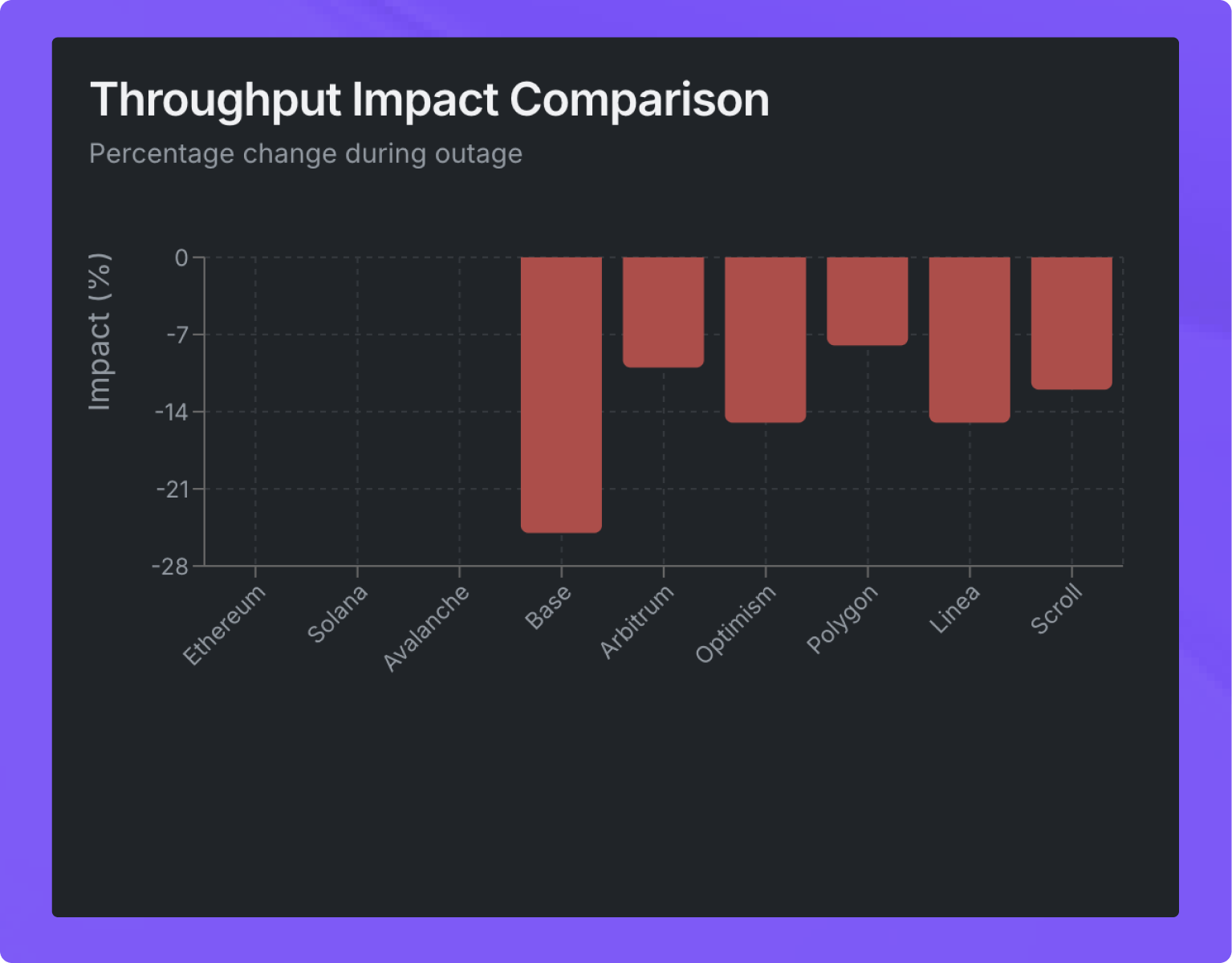
The results exposed a stark divide between architectures. Ethereum, Avalanche and especially Solana passed both tests with continued operations and zero throughput degradation. In contrast, most Layer-2 networks failed the AWS test spectacularly, with Base, Polygon, Optimism, Arbitrum, Linea, and Scroll all experiencing disruptions.
L2s optimized for speed and cost but sacrificed resilience, the one thing that matters in a crisis. October proved that decentralization isn’t a philosophical preference but an operational requirement. The market is now pricing in a resilience premium, and protocols that ignored infrastructure decentralization are facing a reckoning.
Two Trials by Fire
1.1 The Economic Shock (Oct 10-11)
October 10, 2025, delivered the largest single-day liquidation event in cryptocurrency history when President Donald Trump’s announcement of a 100% tariff on Chinese imports at 9:50pm EDT triggered a market-wide cascade. Within 24 hours, $19.16 billion in leveraged positions were liquidated across 1.63 million trader accounts, with roughly $16.7 billion from overleveraged long positions. More than $7 billion in positions were wiped out in the first hour alone, predominantly longs.
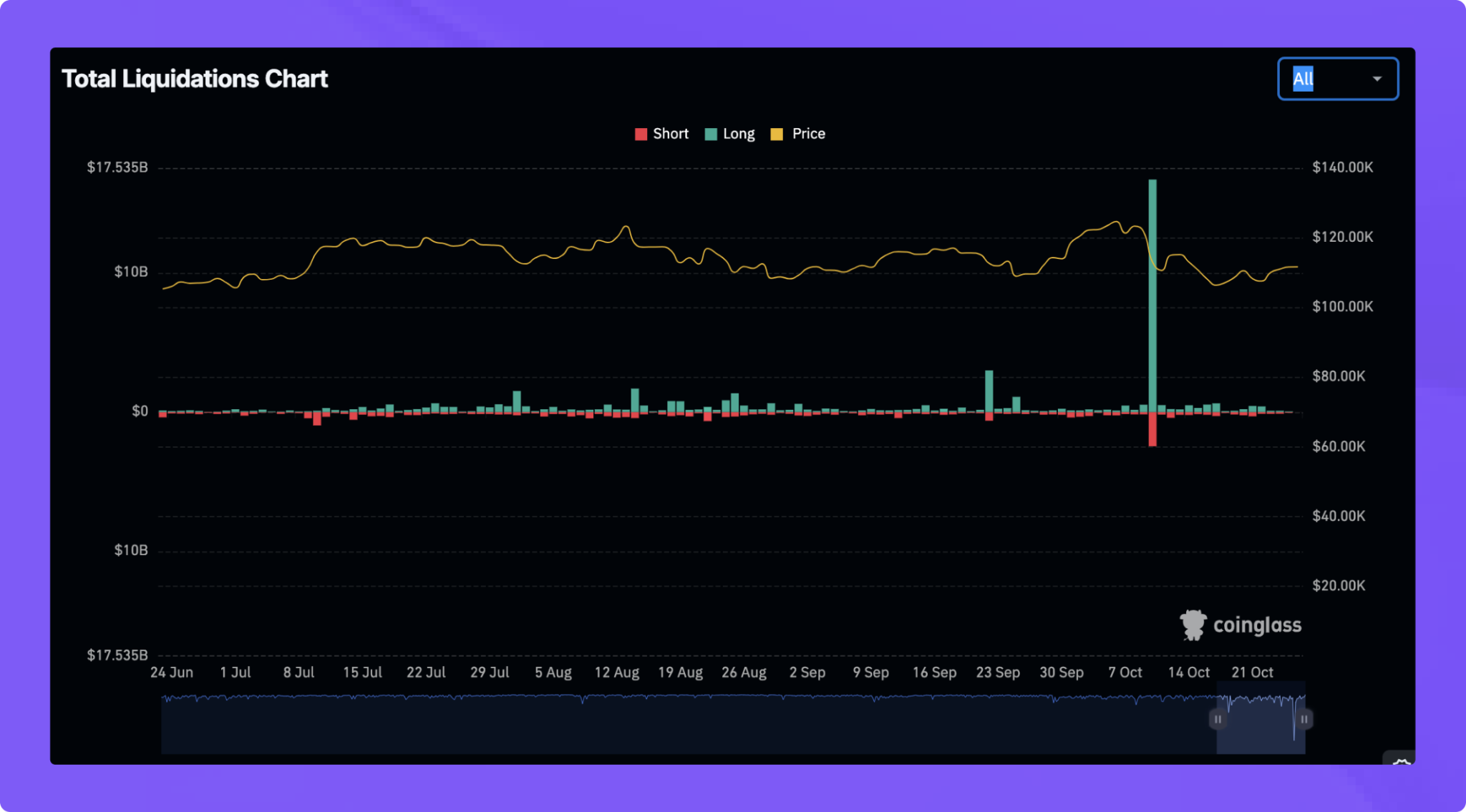
Source: Coinglass
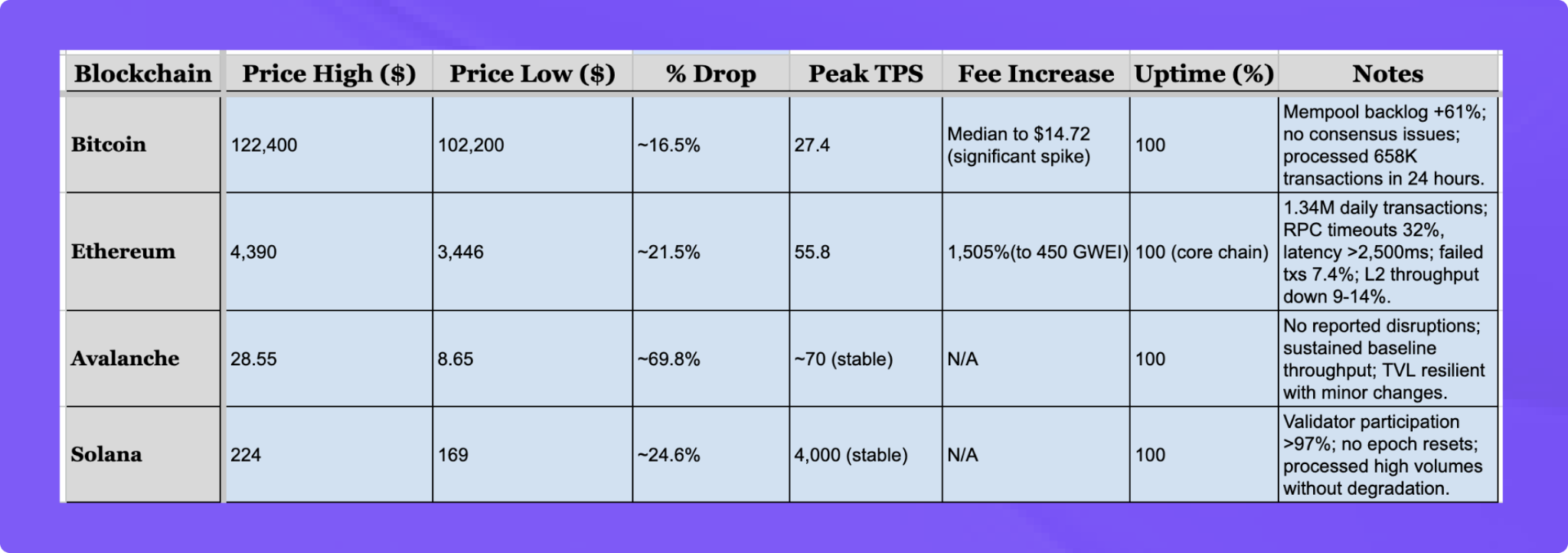
Bitcoin plunged from above $122,400 to briefly touch $102,200, a 16.5% freefall at its lowest point. Ethereum dropped 21.5%, falling from $4,390 to $3,446, while Solana crashed nearly 24.6% from $224 to $169. The crash wiped out a total of $560 billion in total market capitalization.
1.2 The Infrastructure Shock (Oct 19-20)
Just ten days later, the crypto industry faced a different kind of stress test. On October 20, 2025, Amazon Web Services experienced a major 15-hour outage originating from DNS and DynamoDB issues in its US-EAST-1 region, affecting 58 services globally.
The infrastructure failure exposed crypto’s centralized vulnerabilities across multiple platforms. Coinbase, its Base layer-2 network, Robinhood, and ConsenSys’ Infura all went offline. Infura, which powers MetaMask and countless dApps, reported disruptions affecting Ethereum Mainnet, Polygon, Optimism, Arbitrum, Linea, Base, and Scroll.
Source: AWS Blockchain Tracker
A Tale of Two Architectures
2.1 The Economic Shock: A Test of Throughput & Accessibility
The October 10 liquidation cascade created an unprecedented demand for blockchain blockspace, pushing network architectures to their absolute limits. As traders rushed to manage positions, the event became a real-world stress test, revealing a stark divide between protocols built for high-volume and those that buckled under pressure.
Ethereum’s Accessibility Crisis
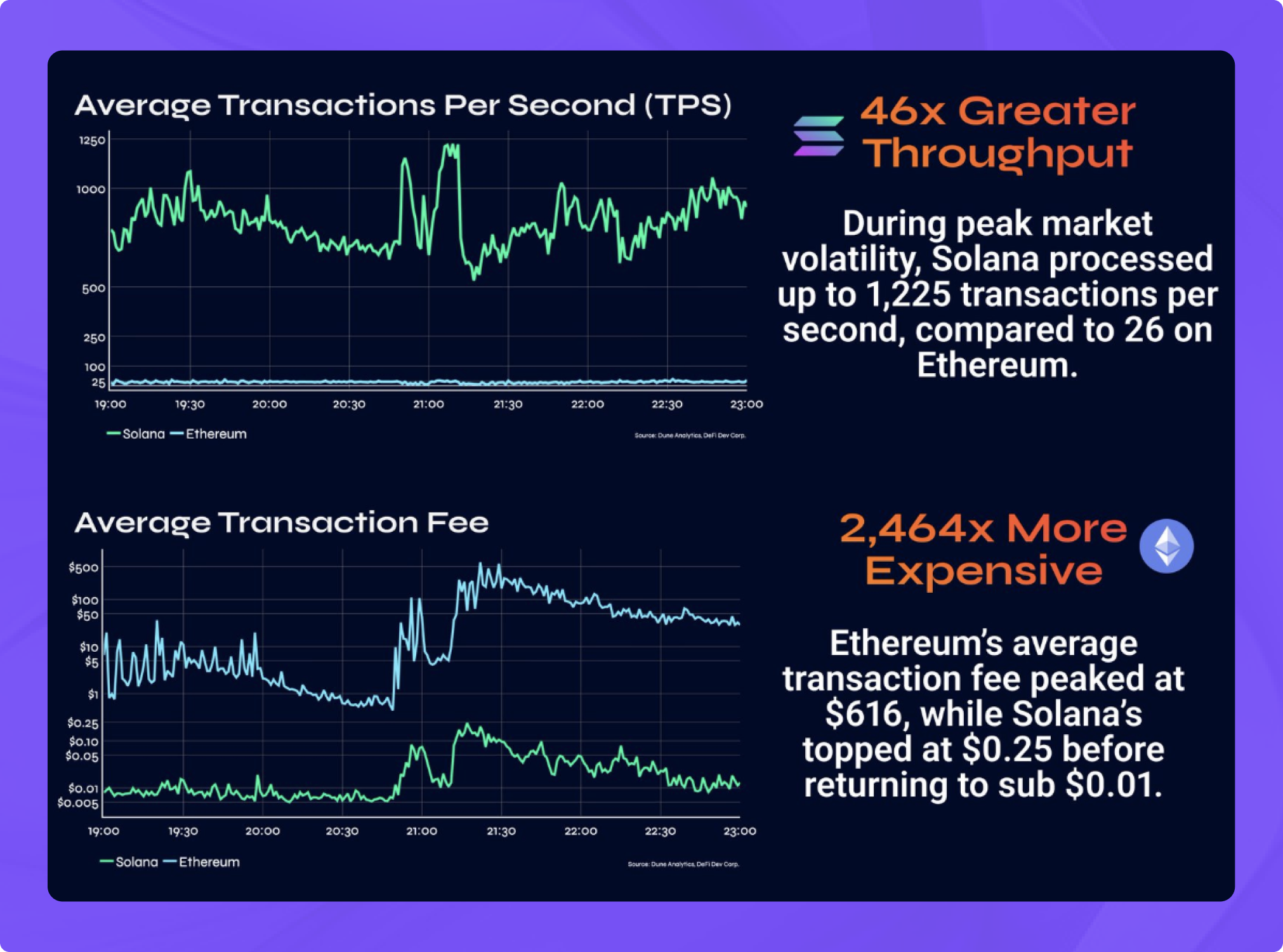
To its credit, the Ethereum base layer remained online and continued producing blocks without interruption. However, from a user’s perspective, the network became practically unusable. The surge in demand caused a dramatic spike in transaction costs, with the average gas fee peaking at a staggering $616. At the same time, the network’s throughput was capped at approximately 26 transactions per second (TPS). This combination of astronomical fees and limited capacity rendered the network economically inaccessible for all but the most desperate or well-capitalized users, highlighting the base layer’s critical constraints during a market-wide crisis.
Source: DeFi Dev Corp
Solana’s Dominant Performance
In stark contrast, Solana was built for this exact scenario. The network flawlessly handled the tidal wave of transactions without significant degradation. At the peak of the volatility, Solana processed up to 1,225 TPS, a throughput 46 times greater than Ethereum’s.
Crucially, this performance did not come at the expense of users. Solana’s transaction fees topped out at a mere $0.25 before returning to sub-cent levels, making it over 2,400 times more affordable than Ethereum at its most congested. With blocks finalizing in 350 milliseconds, the network provided the speed, capacity, and low cost necessary for users to navigate the chaos effectively, proving its architecture was uniquely suited for moments of extreme network demand.
This summary table provides the definitive data on Layer-1 performance during the crash, quantifying the stark architectural divide:
The Centralized Bottleneck
The crisis also exposed the fragility of centralized access points. Major platforms like Coinbase and Robinhood buckled under the load, experiencing severe congestion, API delays, and frozen interfaces. This created a critical bottleneck, locking users out of their funds during the most critical moments and distorting price discovery across the market.
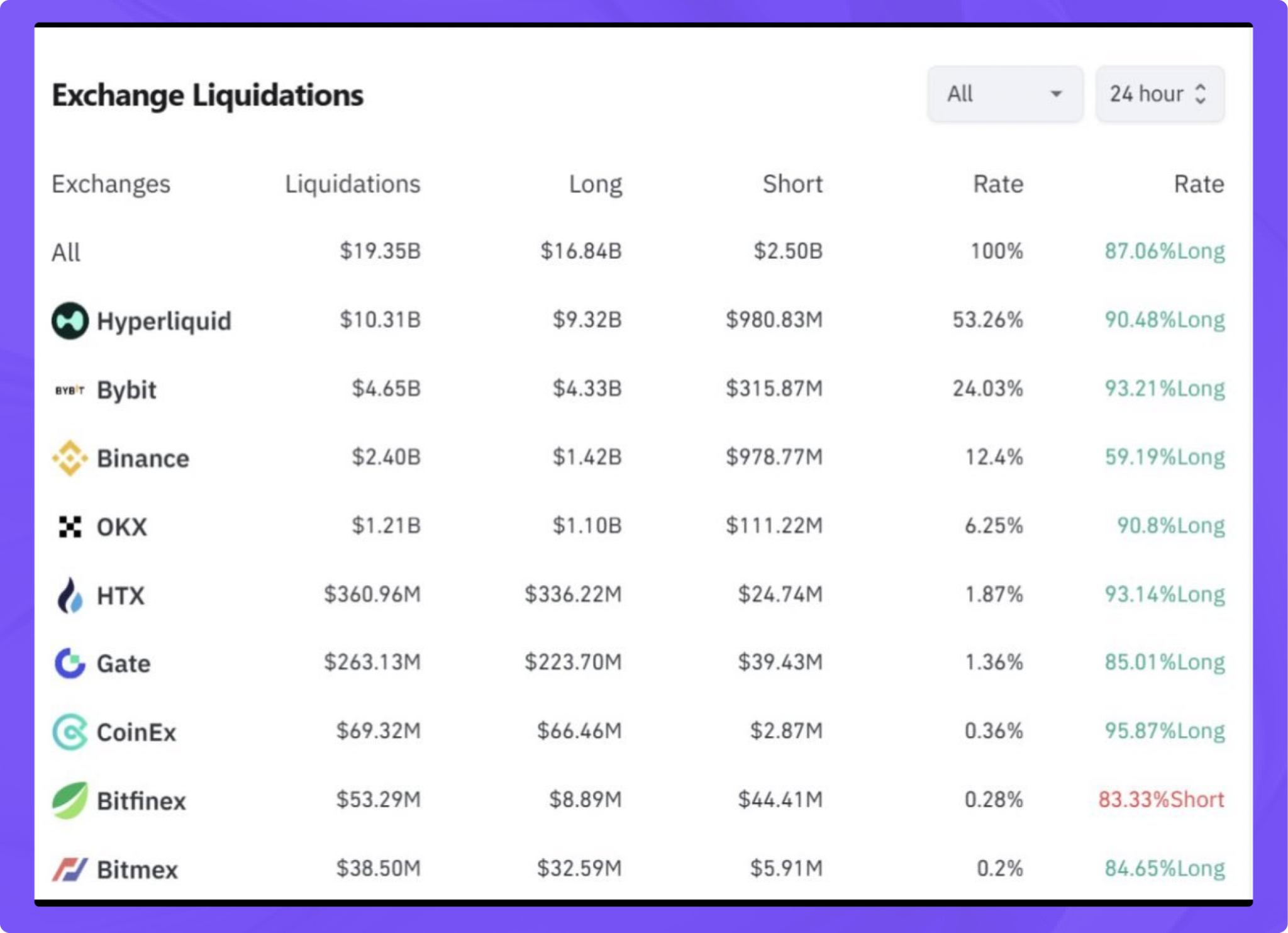
Source: CCN
While centralized venues faltered, on-chain protocols demonstrated remarkable resilience. The liquidation data reveals a stunning outcome: Hyperliquid, a decentralized perpetuals exchange, single-handedly processed $10.31 billion in liquidations i.e over 53% of the total volume across all tracked venues. This performance proved that well-designed DeFi protocols could not only remain fully operational but vastly outperform their centralized counterparts, offering a more robust and accessible alternative during peak market chaos.
2.2 The Infrastructure Shock: A Test of True Decentralization
If the crash was a test of throughput, the 15-hour AWS outage was a brutal audit of decentralization. While major L1s like Ethereum and Avalanche passed by remaining operational, Solana excelled. It recorded zero throughput drop, a direct result of its architectural resilience and minimal 6% validator dependency on AWS. The market rewarded this proven decentralization, with its stablecoin market cap surging past $15 billion post-outage.
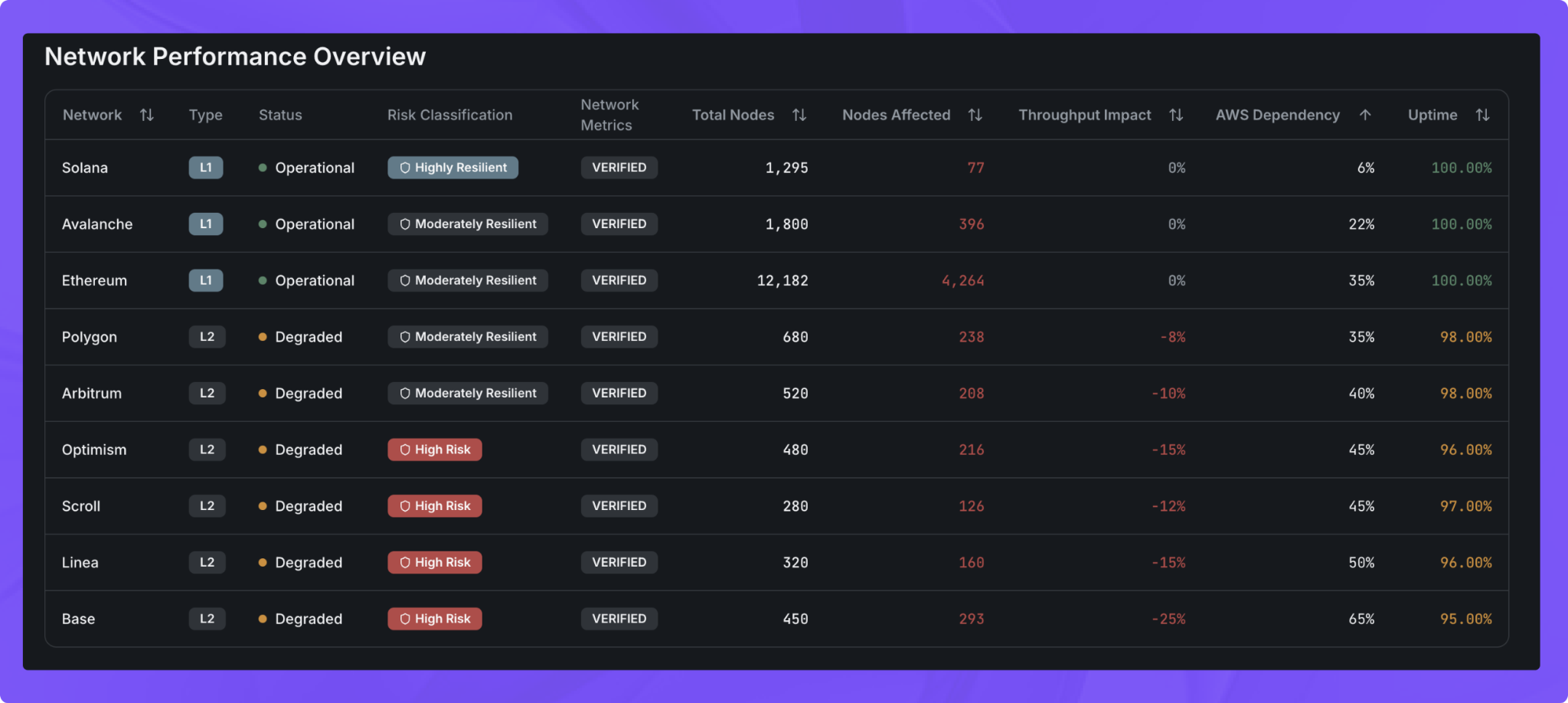
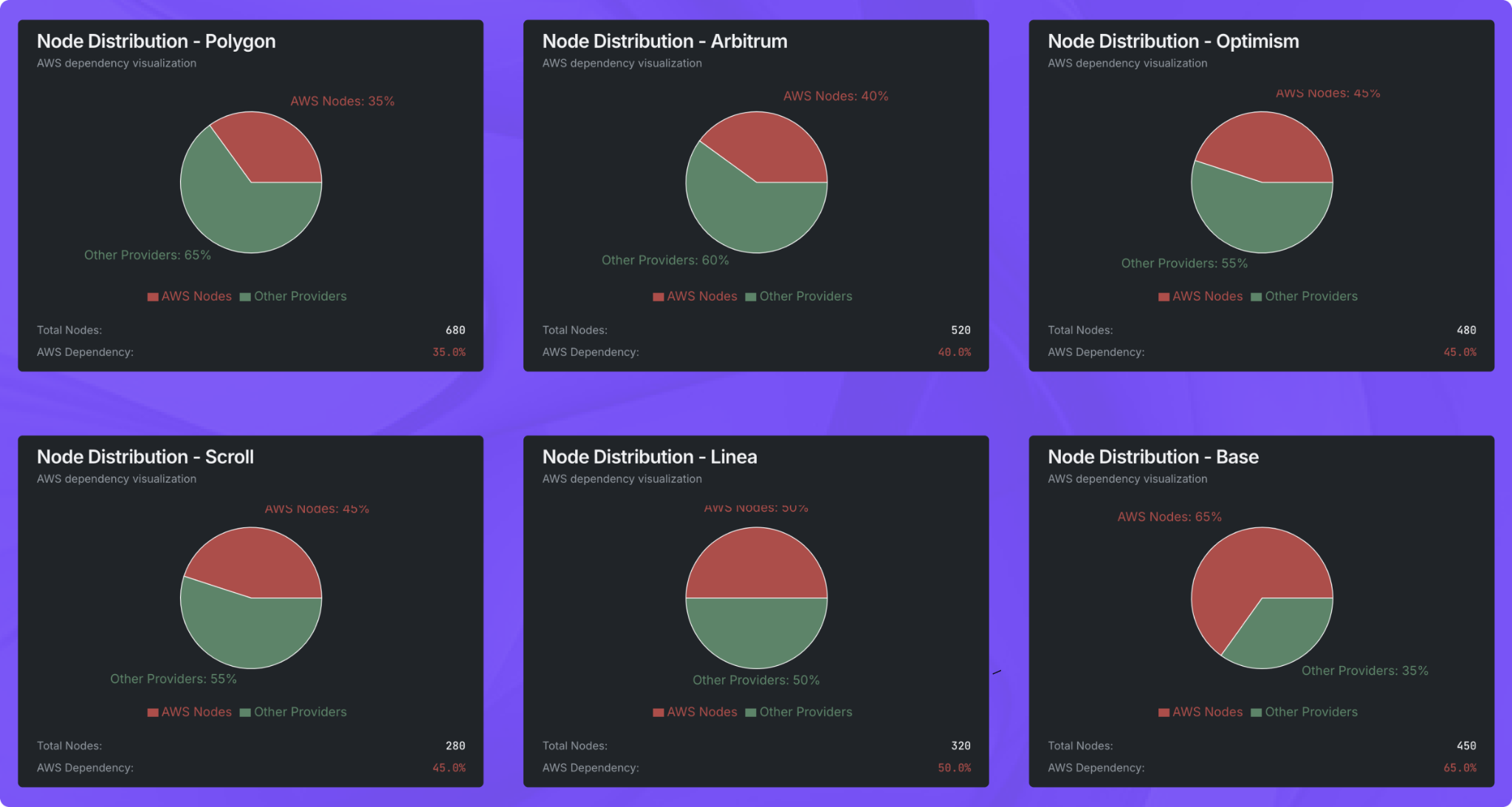
In stark contrast, the L2 ecosystem suffered a catastrophic, systemic failure. Networks including Base, Polygon, Optimism, and Arbitrum went dark. Though their consensus layers were technically live on Ethereum, their deep-rooted dependency on centralized infrastructure (from sequencers on AWS to RPC providers like Infura) made them completely unreachable.
The failure was so absolute it prompted a damning verdict from industry builders. As Sei Labs’ co-founder Jay Jog stated, “Base going down when AWS goes down is literally the entire argument in favour of EVM L1s... The vast majority of L2s... could be bricked by a big enough Web2 outage.”
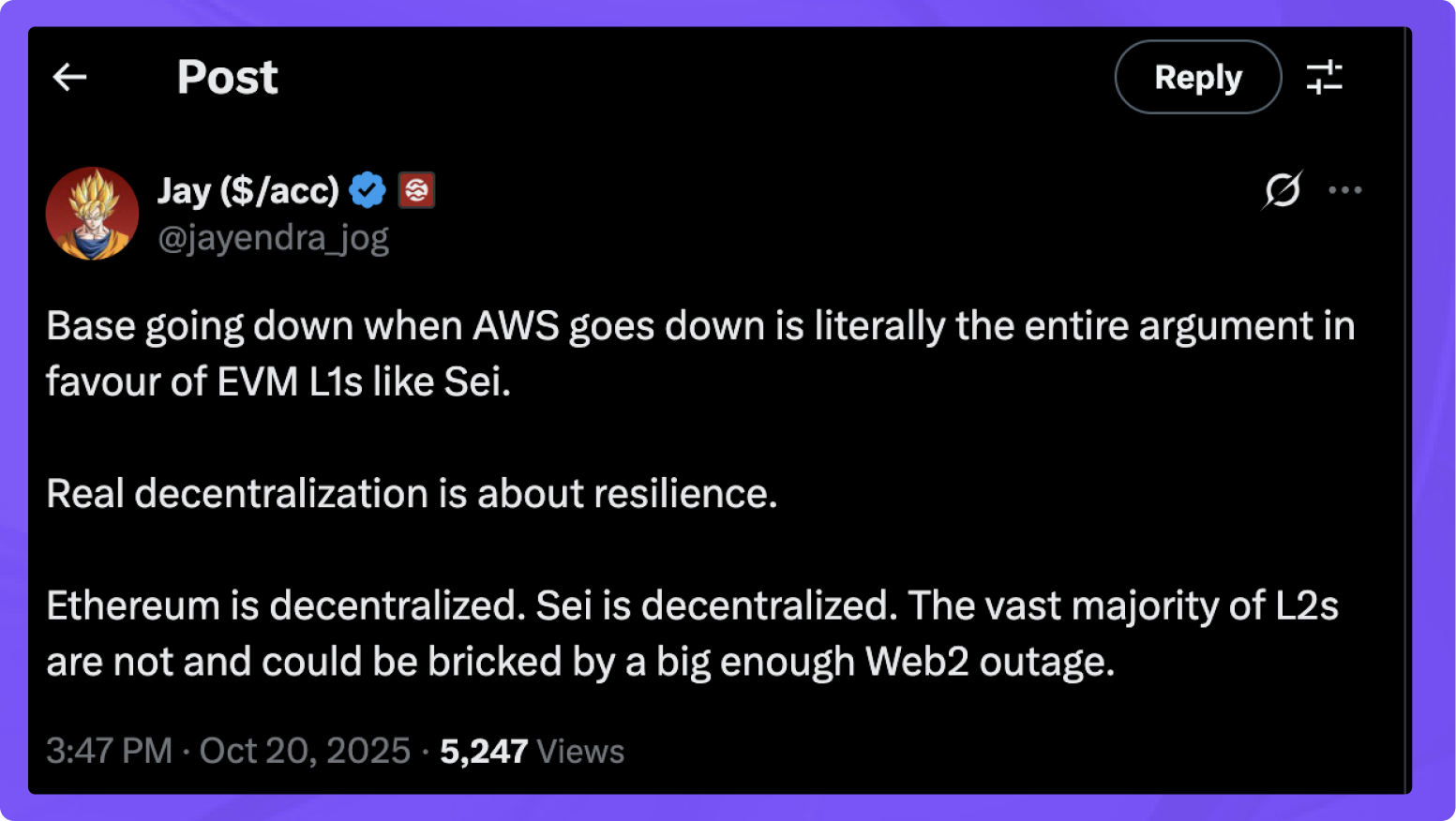
While L2 proponents argue these are early-stage growing pains, the crisis revealed a fundamental architectural risk that users and capital are now pricing in, favoring the battle-tested resilience of truly decentralized L1s.
The Four Layers of Decentralization
The October crisis exposed a fatal flaw in how the industry assesses resilience: an obsession with consensus-layer decentralization while ignoring the fragile infrastructure stack beneath. A true audit requires a more holistic, four-layer framework.
Layer 1: Consensus (Protocol): Asks: Who validates transactions? While many L1s pass this test, Solana’s globally distributed validator set proved its mettle during both events without failure.
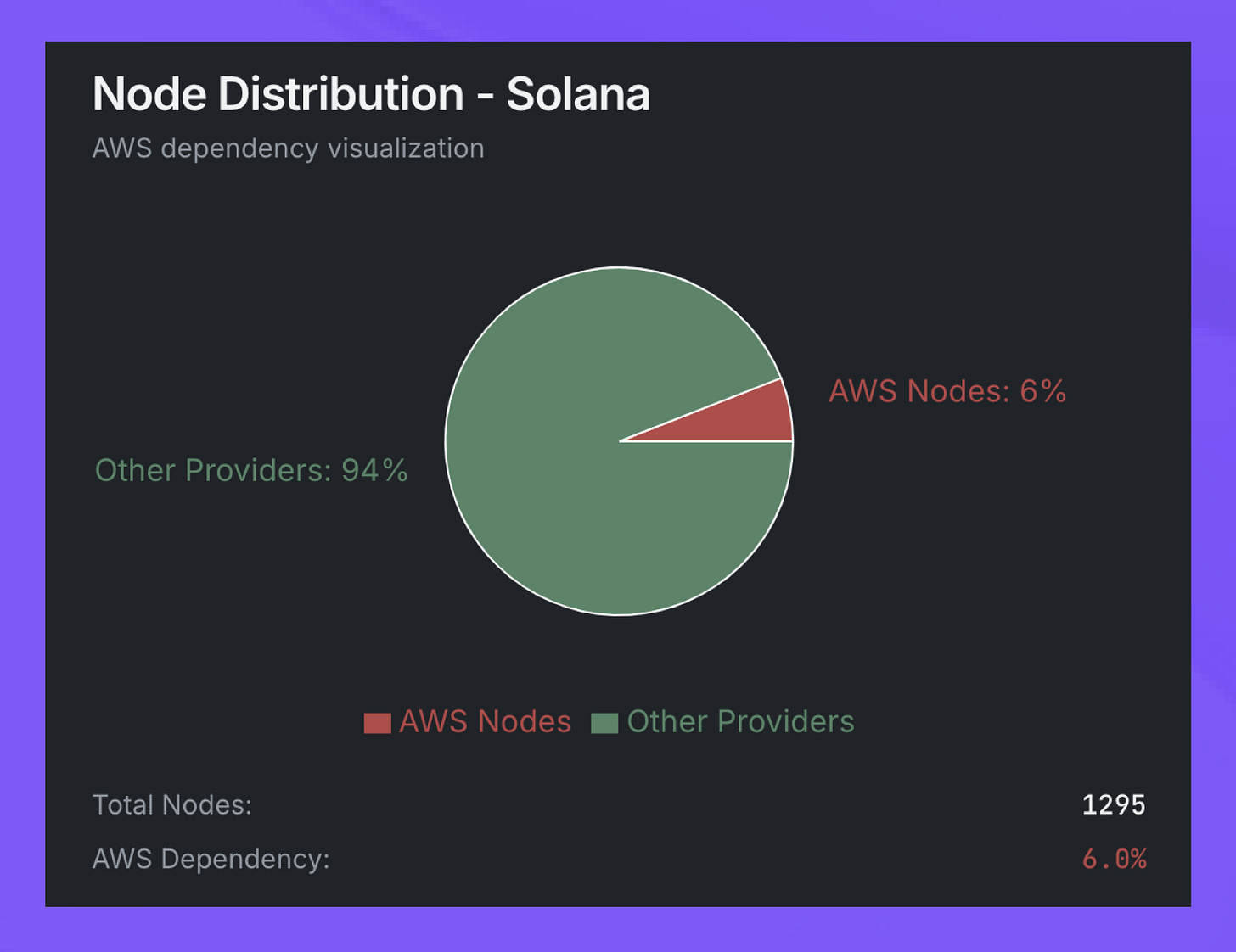
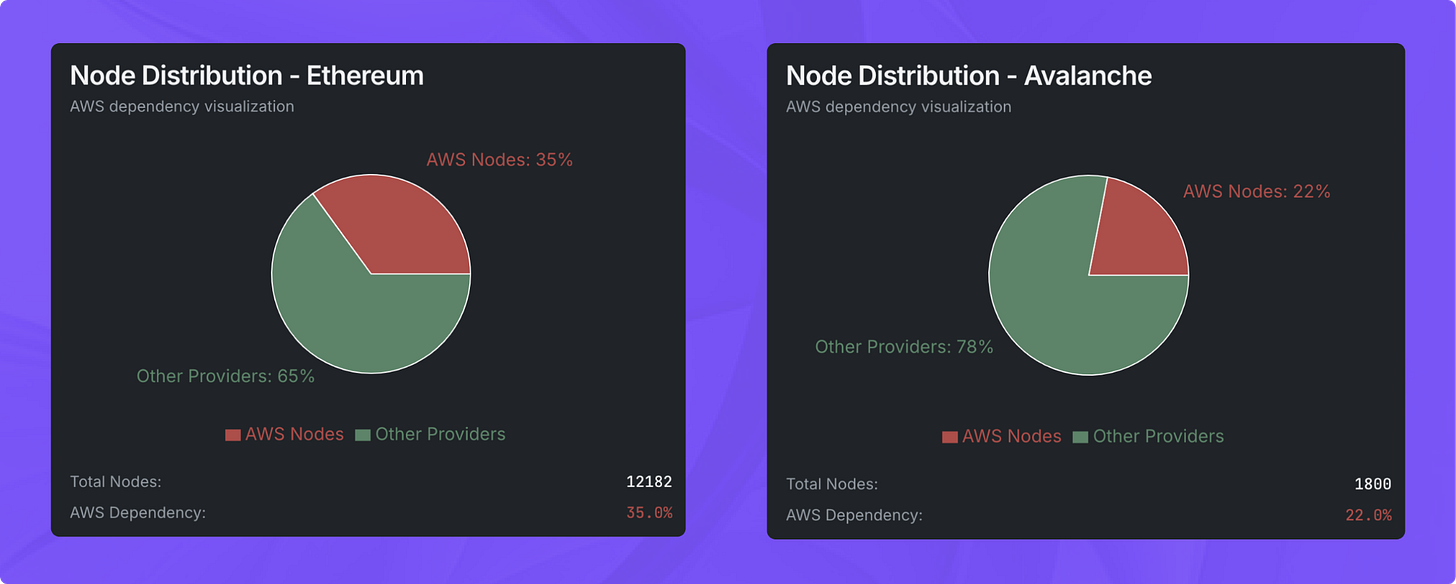
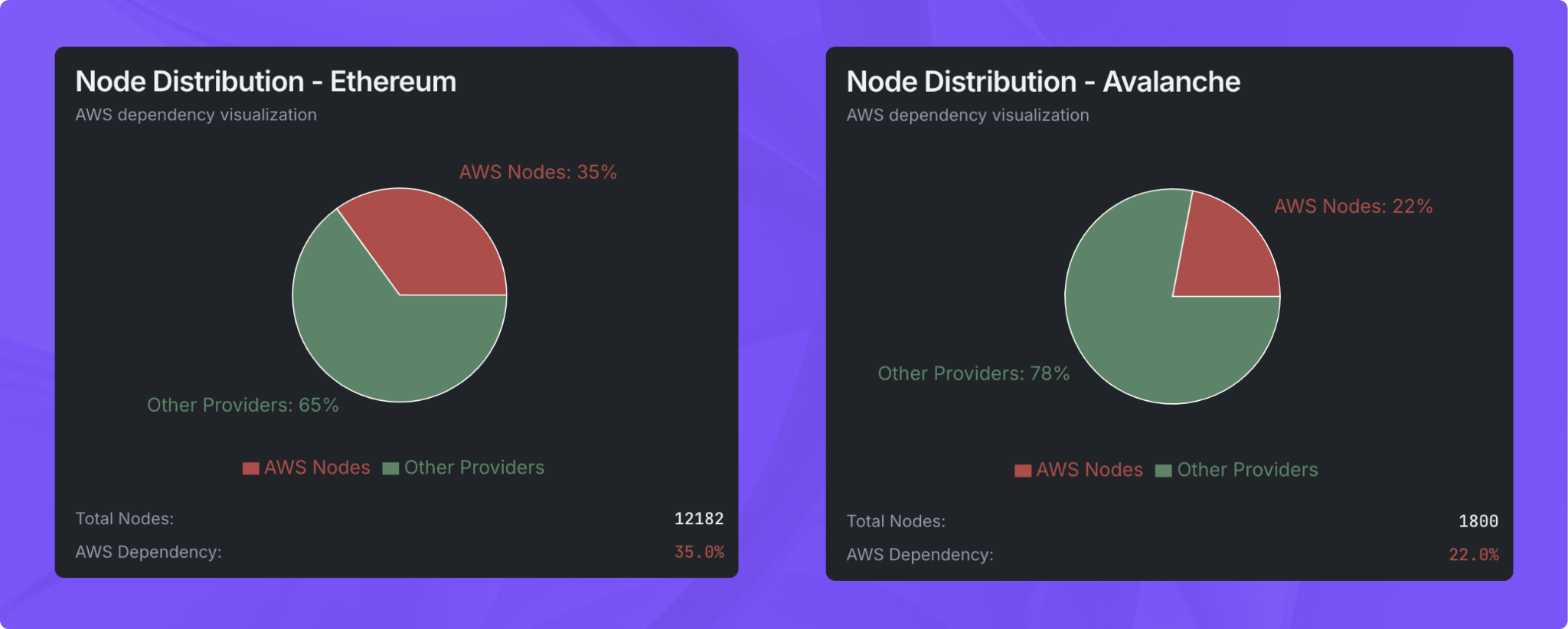
Layer 2: Infrastructure (Nodes): Asks: Where do nodes actually run? This is where the divide became a chasm. While 35% of Ethereum nodes and 22% of Avalanche nodes run on AWS, creating systemic risk, Solana’s mere 6% dependency made it functionally immune to the outage, a clear architectural victory.
Layer 3: Access (RPC/API): Asks: Can users actually connect? L2s proved that a chain is functionally dead if its centralized RPC gateways like Infura go down; a distinction without a difference for any user trying to access their funds.
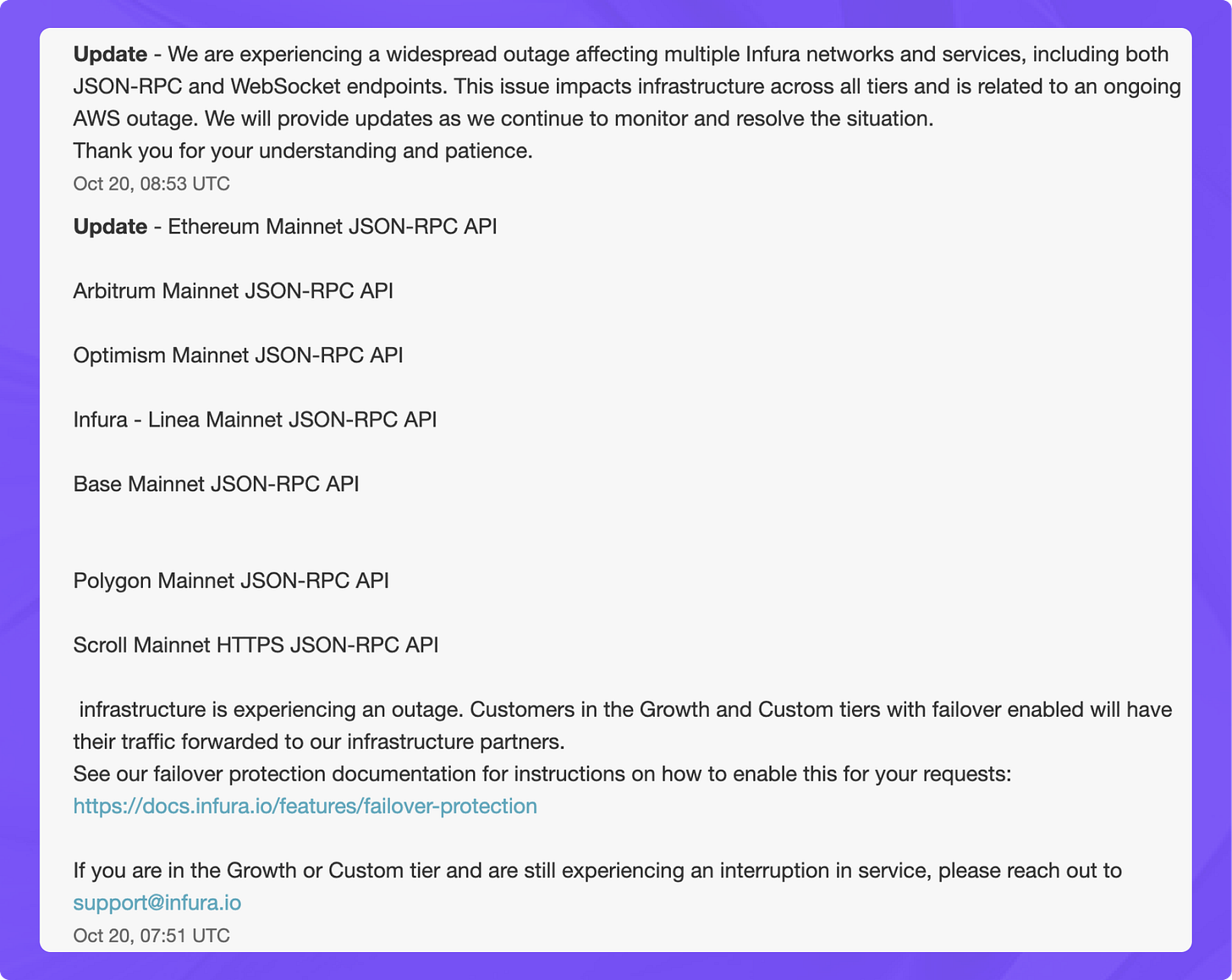
Source: Infura Layer 4: Application (Frontend): Asks: Where are interfaces hosted? The Coinbase and Robinhood outages showed that centralized frontends are the final chokepoint, rendering even a perfect underlying blockchain useless.
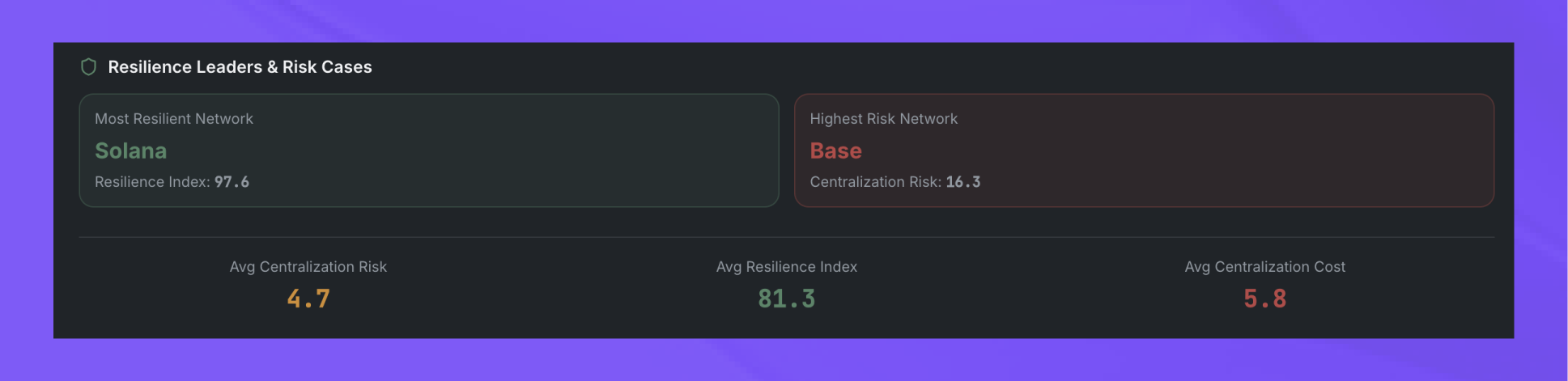
This framework reveals the stark L2 paradox: in optimizing for speed, they concentrated catastrophic failure points across the infrastructure and access layers. In contrast, Solana demonstrated comprehensive, multi-layered resilience. The crisis proved that for a network to be truly unstoppable, decentralization must be engineered into every layer of the stack, not just marketed at the protocol level.
Implications & Future Outlook
The October crisis was a reckoning that ended the era of “decentralization theater.” Multi-layer resilience is now the primary metric for evaluating any protocol, with profound implications for the entire industry.
For Investors: The Rise of the Resilience Premium
Investors now understand that cryptographic soundness is worthless if a network is unreachable. A clear “resilience premium” is emerging as capital rotates toward protocols with proven, multi-layered decentralization. The proof is in the capital flows. Solana’s stablecoin market cap surging past $15 billion post-outage is the new blueprint, proving institutional confidence follows demonstrated reliability, not just whitepaper promises. Due diligence must now evolve to audit the entire stack, from node distribution to cloud provider dependency.
For Builders: An Existential Technical Imperative
The message to developers is now existential: decentralize the entire stack or risk obsolescence. For Layer-2 protocols, this is an urgent crisis. Sequencer decentralization must shift from a vague roadmap item to the highest priority. Resilient, high-throughput L1s like Solana have now set the industry standard for performance under fire, and the L2 value proposition is fundamentally threatened until they can prove they are not simply centralized points of failure.
For the Industry: A Push for Radical Transparency
This crisis forces the industry to mature. Widespread dependency on centralized providers invites regulatory scrutiny and demands a new standard of transparent infrastructure disclosure. Users and investors deserve to know the full dependency stack of any protocol they trust. The path forward requires a new era of radical transparency, moving beyond just consensus details to verifiable, end-to-end resilience.
Conclusion
The October 2025 crisis was a trial by fire, a forced audit of who is truly decentralized and who is merely performing. The verdict was unambiguous; while centralized infrastructure buckled and much of the Layer-2 ecosystem went dark, one network demonstrated a level of resilience that set a new industry standard - Solana.
This was not an accident; it was vindication. During the market crash, Solana processed 46 times more transactions than Ethereum at a fraction of the cost, proving its capacity for extreme volatility. During the 15-hour AWS outage, its minimal cloud dependency allowed it to maintain 100% uptime with zero degradation, proving its architectural robustness. This is resilience earned through genuine engineering, a stark contrast to the theoretical promises of its competitors.
The events of October proved that decentralization is not a feature to be added later, it is the fundamental requirement for survival. The “Resilience Premium” is no longer a theory; it is a market-wide capital rotation toward battle-tested protocols that deliver in a crisis. While others just talked about building a decentralized future, the stress tests revealed which team had already built it. The market is finally learning to tell the difference.
References
AWS (2025). Blockchain AWS Outage Analysis Tool. [online] Awsblockchaintracker.com. Available at:
https://www.awsblockchaintracker.com/
[Accessed 25 Oct. 2025].
Ciccomascolo, G. (2025). Amazon’s AWS Outage Knocks Coinbase, Robinhood and Others Offline: Full List of Impacted Platforms. [online] CCN.com. Available at: https://www.ccn.com/education/crypto/aws-outage-coinbase-robinhood-venmo-list-of-affected-platforms/ [Accessed 25 Oct. 2025].
CoinGecko (2025). Bitcoin (BTC) price, marketcap, chart, and Info. [online] CoinGecko. Available at: https://www.coingecko.com/en/coins/bitcoin [Accessed 24 Oct. 2025].
Coingecko (2025). Ethereum (ETH) price, marketcap, chart, and info. [online] CoinGecko. Available at: https://www.coingecko.com/en/coins/ethereum [Accessed 24 Oct. 2025].
CoinGecko - Solana (2025). Solana price, SOL chart, market cap, and info. [online] CoinGecko. Available at: https://www.coingecko.com/en/coins/solana [Accessed 24 Oct. 2025].
DeFiDevCorp (2025). [online] X (formerly Twitter). Available at: https://x.com/defidevcorp/status/1977739340446048722 [Accessed 24 Oct. 2025].
Infura (2025). Infura Status. [online] Infura.io. Available at:
https://status.infura.io/?utm_source=newsletter&utm_medium=email&utm_campaign=aws-outage-takes-down-coinbase
[Accessed 24 Oct. 2025].
Jayendra_jog (2025). [online] X (formerly Twitter). Available at: https://x.com/jayendra_jog/status/1980284666906370173 [Accessed 24 Oct. 2025].
Oluwapelumi Adejumo (2025). How today’s AWS glitch took down Coinbase, ETH L2s, and half the internet. [online] CryptoSlate. Available at: https://cryptoslate.com/aws-failure-exposes-cryptos-centralized-weak-point/ [Accessed 24 Oct. 2025].
SINGH, O. (2025). Oct. 10 Crypto Flash Crash: Here’s Which Exchanges, Whales and Traders Lost the Most — and What’s Next. [online] CCN.com. Available at: https://www.ccn.com/education/crypto/oct-10-crypto-flash-crash-exchanges-whales-traders-who-lost/ [Accessed 24 Oct. 2025].
Singh, O. (2025). $19 Billion Crypto Liquidation: How Trump’s 100% China Tariff Threat Triggered the Biggest Crash Ever. [online] CCN.com. Available at: https://www.ccn.com/education/crypto/cryptos-19-billion-liquidation-explained-trump-china-tariff-leverage-crash/ [Accessed 24 Oct. 2025].
Trump, D. (2025). Truth Social. [online] Truth Social. Available at: https://truthsocial.com/@realDonaldTrump/posts/115351840469973590 [Accessed 24 Oct. 2025].
 | A guest post by
|